Why Energy Efficiency Matters in 2025
- Most homes waste 20-30% of their energy
- Causes: Inefficient equipment, poor insulation, unconscious habits
- Annual waste: $400-600 you're throwing away
- Electricity rates are rising across deregulated markets
- Efficiency improvements offer highest ROI available
- Payback periods measured in months, not years
Tips 1-5 - No-Cost Quick Wins That Start Saving Today
- Phantom loads waste 5-10% of your home's energy
- Unplug chargers when not in use—they draw power even without devices
- Use power strips for entertainment centers and office equipment, flip off at night
- Adjust 7-10°F for eight hours daily (sleeping or away)
- Summer: 78°F when home, higher when away
- Winter: 68°F during day, lower at night
- Run dishwashers and washing machines only with full loads
- Partial loads waste water, energy, and detergent
- Heating water accounts for 90% of a washing machine's energy use
- Modern detergents work effectively in cold water
- Open curtains during day to reduce lighting needs
- Use ceiling fans instead of AC when possible—fans use 90% less energy
Tips 6-7 - LED Lighting and The Fastest ROI Home Upgrade
- 60-watt incandescent (4 hours/day): ~$7/year
- 10-watt LED equivalent: ~$1.40/year
- Savings per bulb: $5.60/year
- LED cost: $2-5 each
- Payback period: 6-18 months
- Average home has 30-40 bulbs
- Annual savings: $150-200 after initial investment
- Dimming LEDs by 25% saves 20% energy
- Motion sensors eliminate "lights left on" waste
- Outdoor motion lights improve security while saving energy
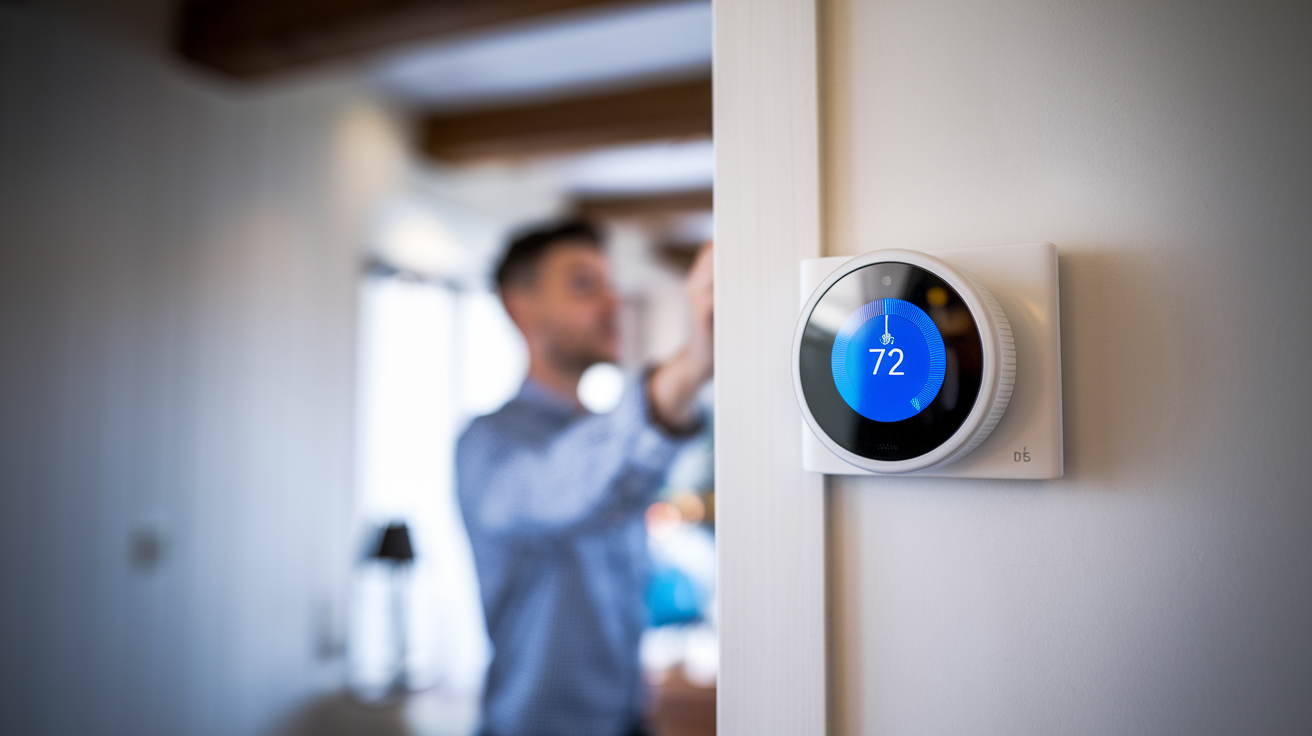
Tips 8-9 - Smart Thermostats and Set It and Forget It Savings
- Average household HVAC spend: $800-1,000/year
- Annual savings: $64-260
- Payback period: 6-36 months
- Installation: ~30 minutes (no electrician needed for most systems)
- Utility rebates: $50-100 available
- Learning algorithms: Adapt to your schedule automatically
- Geofencing: Adjusts when you leave/return home
- Remote control: Never heat or cool an empty house
- Set vacation mode when traveling
Tips 10-13 - HVAC Optimization and Managing Your Biggest Energy User
- Dirty filters increase energy use by 5-15%
- Check monthly, replace every 1-3 months
- Cost: $5-20 per filter
- Tuned-up systems run 15-20% more efficiently
- Cost: $75-150 per visit
- Annual savings: $150-300
- Leaky ducts waste 20-30% of conditioned air
- Professional duct sealing: $300-500
- Annual savings: $200-400
- Keep clear of debris and vegetation
- Maintain two feet clearance around unit for proper airflow
- Clean condenser coils annually
Tips 14-16 - Weatherization and Insulation as Invisible Money Savers
- Identify your biggest energy loss opportunities
- Many utilities offer free or subsidized audits
- Professionals use thermal imaging to show exactly where your home bleeds energy
- Most homes need R-38 to R-60 depending on climate
- If you can see ceiling joists, you need more insulation
- DIY-friendly project: $1-3 per square foot
- Highest ROI weatherization project
- Seal first, then insulate—order matters
- Focus on gaps around windows, doors, outlets, and plumbing
- Cost: Under $50 total for caulk and weatherstripping
- Eliminates drafts costing hundreds annually
Tips 17-19 - Energy-Efficient Appliances and When to Replace Them
- Modern models use 40% less energy than 15-year-old units
- Pre-2010 fridge? Save $100-150 annually by replacing
- Top-freezer models are 10-25% more efficient than side-by-side
- Front-loaders use 45% less water and 25% less energy
- Better spin extraction reduces dryer time
- Check utility rebates: $50-200 often available
- Energy Star dishwashers use less water than hand washing
- Skip the heated dry cycle—air dry to save more
- Run only full loads for maximum efficiency
Tips 20-22 - Water Heating Efficiency and The Overlooked Opportunity
- Most heaters set to 140°F (too hot)
- 120°F is perfectly adequate for households
- Saves 3-5% in heating costs ($30-60/year)
- Tank blanket: $20-30
- Pipe insulation (first 6 feet): $10-15
- Combined savings: $20-45 annually
- Payback: Under 1 year
- Each minute less saves 2.5 gallons of hot water
- Family of 4 cutting 2 minutes each saves $100+/year
- Low-flow showerheads maintain pressure while using less water
Tips 23-25 - Additional Quick Wins
- That garage or basement fridge costs $50-150/year to run
- Often only used occasionally—unplug when not needed
- Old models are especially inefficient
- Automatically cut power when devices enter standby
- Cost: $25-40 each
- Eliminates phantom loads without manual unplugging
- Perfect for entertainment centers and home offices
- Reduces your price per kWh—independent of usage
- Savings of 15-25% on supply charges
- No installation, no service interruption
- Compare rates at ElectricRates.org
How ElectricRates.org Maximizes Your Total Savings
- Efficiency – Reduces your usage (kWh)
- Competitive rates – Reduces your price (¢/kWh)
- Combined impact – Up to 44% total bill reduction
- Starting bill: $167/month
- After efficiency improvements: $117-134/month
- After switching supplier: $84-116/month
- Total savings: $50-83/month or $600-996/year
- Enter your ZIP code
- See real offers from licensed suppliers
- Switch online in minutes
- No installation, no service interruption, no fees
- Your utility still delivers power and fixes outages
- You just pay less
Your Home Energy Action Plan - Next Steps for Maximum ROI
- Adjust thermostats, unplug phantom loads, optimize appliance use
- Cost: $0
- Savings: $200-400/year
- Replace high-use bulbs with LEDs
- Install a smart thermostat
- Cost: $150-300
- Savings: $150-350/year
- Payback: 6-18 months
- Air seal and add insulation
- Get a professional energy audit
- Cost: $300-1,200
- Savings: $220-500/year
- Schedule professional tune-up
- Seal ductwork if needed
- Cost: $75-650
- Savings: $200-400/year
- Replace failing appliances with Energy Star models
- Check ElectricRates.org quarterly for competitive supplier offers
Frequently Asked Questions
What's the fastest way to reduce my electricity bill?
The fastest results come from combining no-cost behavioral changes with competitive electricity rates. Start by unplugging phantom loads (devices drawing power in standby mode), adjusting your thermostat 7-10°F when away or sleeping, and running major appliances only with full loads. These cost nothing and save $165-400 annually. Then check ElectricRates.org for competitive supplier rates in your area—switching can save 15-25% on your per-kilowatt-hour cost immediately, with no installation or service changes required. Together, these strategies can reduce your monthly bill by $30-70 starting with your next billing cycle.
How much can smart thermostats really save?
Smart thermostats save 8-26% on heating and cooling costs, according to EPA studies and manufacturer data from Nest and ecobee. For the average household spending $800-1,000 annually on HVAC (which represents 40-50% of total energy use), that translates to $64-260 in yearly savings. The variance depends on your previous thermostat habits—if you already manually adjusted temperatures when away, you'll see lower savings. If you frequently heated or cooled an empty house, you'll be on the higher end. Most users report ROI within 6-36 months, especially when factoring in utility rebates of $50-100.
Are Energy Star appliances worth the extra cost?
Yes, but with strategic timing. Don't replace working appliances solely for efficiency—wait until they fail or become unreliable. When replacement time comes, Energy Star models save 10-50% on energy use depending on the appliance type. A new Energy Star refrigerator saves $100-150 annually compared to a 15-year-old model. Front-loading Energy Star washers save $45-100 per year versus traditional top-loaders. Over a typical 10-15 year appliance lifespan, you'll save $600-1,500—far more than the $50-200 premium for the Energy Star model. Check your utility's rebate programs before buying.
What's the ROI on LED bulbs?
LED bulbs offer one of the fastest returns on investment for any home improvement. They use 75% less energy than incandescent bulbs and last 25 times longer. A single LED bulb costs $2-5 but saves approximately $5.60 per year compared to a 60-watt incandescent used four hours daily. That means payback in 6-18 months, then pure savings for the next 15-25 years. Across a typical home with 30-40 bulbs, expect annual savings of $150-200 after the initial investment. Start by replacing your most-used lights first to maximize immediate returns.
Should I get a home energy audit?
Absolutely, especially if your home is older than 15 years or you've never done efficiency improvements. Professional energy audits cost $200-500 but many utilities offer them free or subsidized. Auditors use thermal imaging and blower door tests to show you exactly where your home is losing energy—something you can't see with the naked eye. They'll identify the highest-ROI improvements specific to your house, preventing you from wasting money on upgrades that won't deliver returns. Most homeowners discover 3-5 major opportunities worth $300-800 in annual savings.
How does energy efficiency combine with competitive rates?
Energy efficiency and competitive rates attack your bill from two different angles, creating compounding savings. Efficiency reduces how many kilowatt-hours you use—that's cutting the quantity. Competitive rates reduce what you pay per kilowatt-hour—that's cutting the price. In deregulated states like Ohio, Pennsylvania, and Massachusetts, switching to a competitive supplier can save 15-25% on your per-kWh cost with zero changes to service or reliability. Combine that with 20-30% efficiency improvements and you can reduce your total bill by up to 44%. On a $167 monthly bill, that's savings of $50-83 per month or $600-996 annually.
About the author
Consumer Advocate
Brad moved from California to Texas in 2009 and got confused by electricity shopping—something that didn't exist where he came from. That confusion led him to build ComparePower.com. At ElectricRates.org, he's applying the same approach to Ohio, Pennsylvania, and Massachusetts.
Topics covered
Sources & References
- EIA - Residential Energy Consumption Survey (U.S. Energy Information Administration): "Average US household spends approximately $2,004 annually on electricity"Accessed Jan 2025
- ENERGY STAR - Savings Calculator (U.S. Environmental Protection Agency): "ENERGY STAR certified products can save households up to 30% on energy bills"Accessed Jan 2025
- DOE - Weatherization Assistance Program (U.S. Department of Energy): "DOE Weatherization Assistance Program helps low-income families reduce energy costs"Accessed Jan 2025
Last updated: December 10, 2025